Travel with allergies. Without the fear.
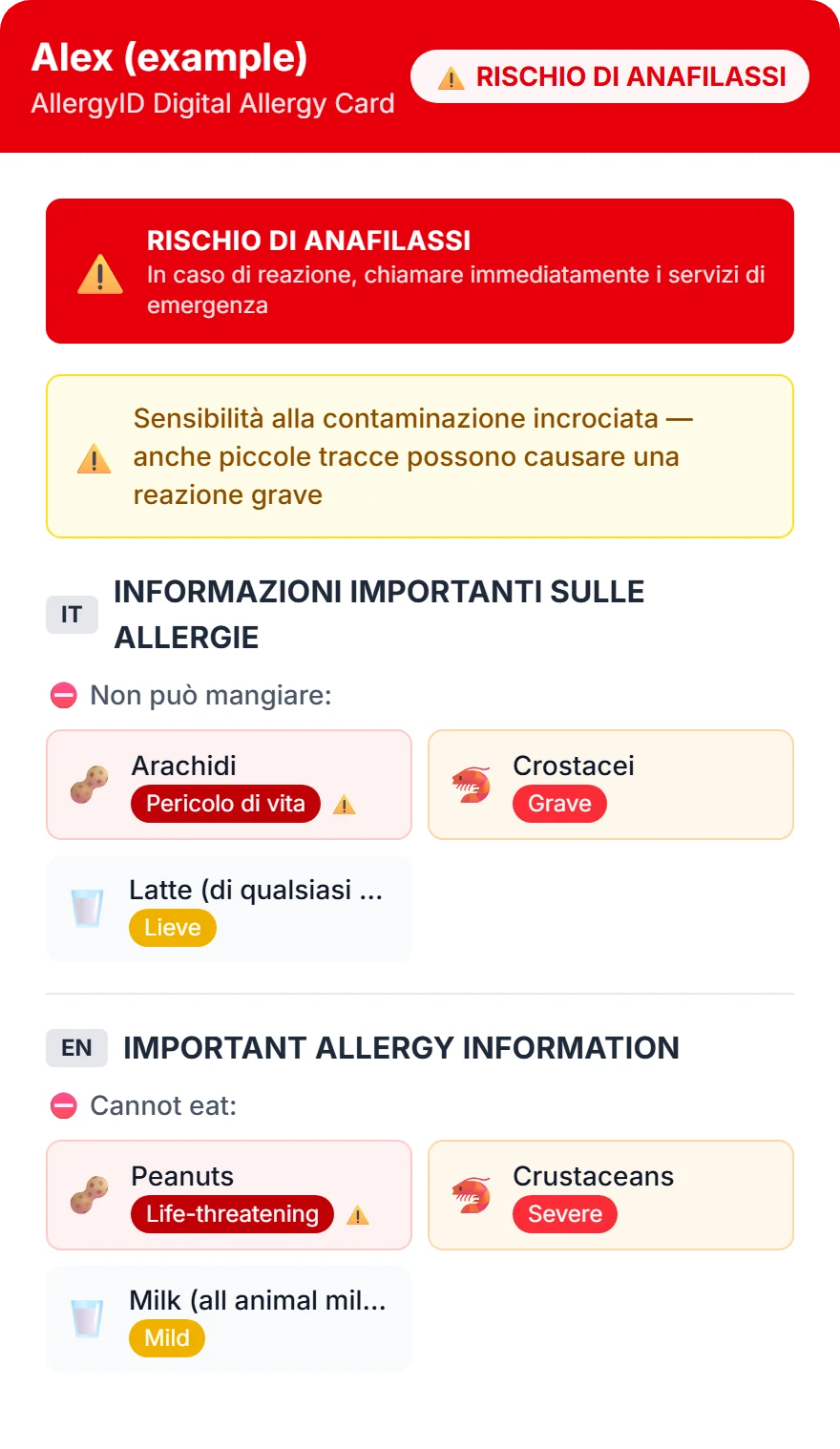
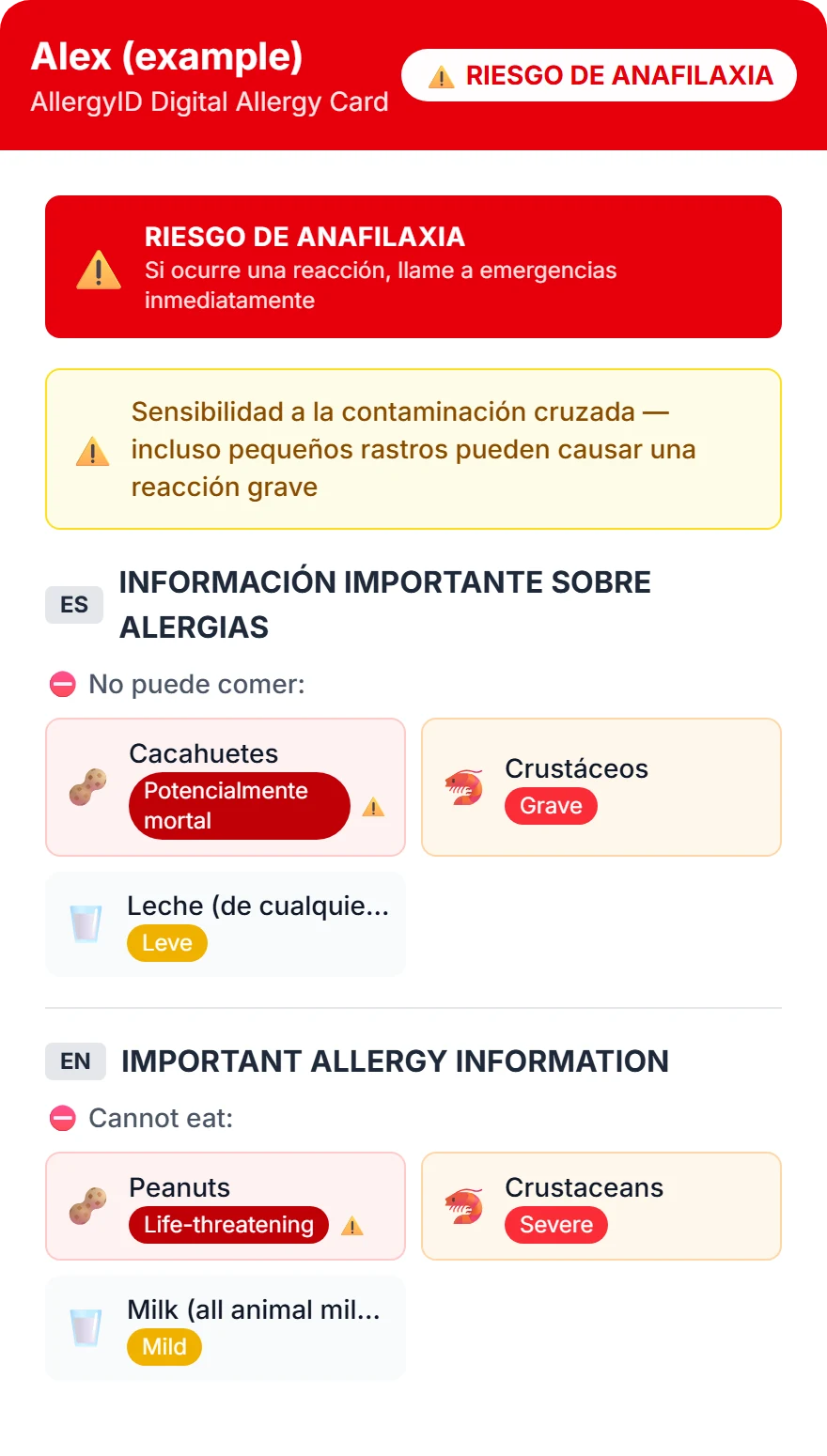
The digital allergy card staff can read in 35 languages, color-coded by severity.
AllergyID is a digital allergy card for people with food allergies, and for parents who manage a child’s. Each allergen on your card shows how serious it is, from mild intolerance to anaphylaxis, so the kitchen sees the risk at a glance.
Free forever for 1 profile. No credit card. No account needed to make your card or to subscribe in the app. Sign up (free) to share it by link or QR code, keep it on more than one device, or use your plan on the web.
Allergen names come from AllergyID’s own fixed dictionary of 700+ terms, so each allergen always reads the same. So far only Icelandic is professionally reviewed; the other languages are machine-translated. See the review status of all 35 languages →
Latest update: . See what changed and the review status of each language
One card. Every language. Every allergen.
If you mostly avoid eating out because your allergy is hard to explain in another language, your card does the explaining.
Create Your Profile
Select your allergens, set severity levels, and add emergency contacts. Takes under 2 minutes.
Auto-Translate
Your card is instantly available in 35 languages, built on a curated allergen dictionary.
Share Anywhere
QR code, link, PDF, PNG, or print. Staff scan it and see your allergies in their language.
For the restaurant or kitchen: reading an AllergyID card
Written for the waiter, chef or school cook who gets the card. It takes a few seconds to read.
- Mild
- Moderate
- Severe
- Life-threatening
Scan the QR code or open the link
No app and no login. The card opens in your phone’s language, and you can switch to another.
Read the colors first
Each allergy shows how serious it is: yellow is mild, orange moderate, red severe and dark red life-threatening. A life-threatening allergy puts an anaphylaxis warning at the top.
Watch for ⚠
⚠ marks an allergen where even small traces can cause a severe reaction, so cross-contamination matters.
In an emergency
Medications are listed with emergency medication first, and you can tap the emergency phone number to call.
The card doesn’t say whether a dish is suitable. It tells you what the guest can’t eat, so you can talk it through and check together. A school or kindergarten link always opens the latest version of the child’s card.
Supported Languages
Severity Levels
From mild intolerance to life-threatening anaphylaxis. Color-coded so restaurant staff understand the risk immediately.
Family Profiles
Manage allergy cards for your whole family. Up to 6 profiles with the Family plan. Share your child’s card with the school or kindergarten kitchen: the link always opens the latest version, for peace of mind when someone else is cooking.
Works Offline
No Wi-Fi? The app keeps your card on your phone, so you can still show it. Whoever scans your QR code needs a connection to open it.
Our own allergen dictionary
Allergen names come from AllergyID’s own allergen dictionary, so each allergen always appears under the same name. So far, only the Icelandic version has been reviewed by professionals. Your card can also hold emergency contacts and medications.
Review status for each language →
Why I built AllergyID
Bjarni Þór Ævarsson, founder of AllergyID
I’m a trained chef and worked in kitchens for 12 years, starting at 14. During a shift, my own allergy gave me an anaphylactic reaction, and I had to be rushed to hospital for adrenaline.
Ever since, I have wanted to help people explain their allergies clearly, whatever language the kitchen speaks, and to break down the language barriers that get in the way. That’s why I built AllergyID.
Made in Akureyri, Iceland, by a chef with a food allergy. Bjarni on LinkedIn About AllergyID
Questions people ask first
Can I trust the translations with my life?
Allergen names come from AllergyID’s own allergen dictionary, so each allergen always appears under the same name. So far, only the Icelandic version has been reviewed by professionals, and Icelandic names changed in October 2026 have not been reviewed yet. The other 34 languages have not been professionally reviewed. Always confirm your allergies with the staff. See the review status of each language
What if the restaurant has no Wi-Fi or signal?
The app keeps your card on your phone, so you can show the screen without a connection. Whoever scans your QR code needs a connection to open it. For places with no signal, save your card as a PNG or print it before you go. Premium adds print-ready PDFs, including a wallet-size one.
How does the card show how serious my allergy is?
Each allergen gets a severity level: mild, moderate, severe or life-threatening. The card color-codes the level in every language on it, and a life-threatening allergy adds an anaphylaxis warning at the top of the card.
Can my card mention cross-contamination?
Yes. Mark an allergen as sensitive to cross-contamination and the card adds a warning that even small traces can cause a severe reaction. When staff scan your QR code or open your link, they see the card in their phone’s language and can switch language. On your own screen, and on a saved or printed card, the warning is at the top in your card’s first language, and the allergen is marked ⚠ in every language. AllergyID does not judge dishes or kitchens; it helps the staff understand what you need, so you can ask and check together.
Do I need to pay just for one trip?
No. The free plan gives you one profile and up to 3 languages, with no time limit. Premium ($4.99 a month or $39.99 a year) adds all 35 languages and print-ready PDFs, and you can cancel any time.
Can I use it for my child at school or kindergarten?
Yes. Share the card’s link or QR code with the school or kindergarten kitchen. The link always opens the latest version, so when you update an allergy, the kitchen sees the change the next time they open it.
Who is AllergyID for?
People with food allergies, intolerances or celiac disease, and parents who manage a child’s allergies. You can also list foods you avoid for religious or ethical reasons. AllergyID is not a menu checker or a diet planner, and it never tells you whether a dish is suitable for you: it helps you tell the staff what you can’t eat. It is not made for restaurants or food businesses that want to label their menus.
Does AllergyID find restaurants or scan food labels?
No. It does one job: telling the people who make your food what you can’t eat. It has no restaurant reviews or ratings, no barcode scanner and no menu reader. If you use another app to choose where to eat, AllergyID is the card you show when you get there.
Does AllergyID replace a medical ID bracelet?
No. A medical ID speaks for you in an emergency. AllergyID is for the moment before the food is made: it tells staff what you can’t eat. It does not watch over you, alert anyone or contact emergency services. If you wear a medical ID, keep wearing it. Your card can show an emergency contact, and on a scanned card the phone number can be tapped to call.
Is AllergyID an allergy translation card or a chef card?
It does the same job. An allergy translation card, also called a chef card or restaurant allergy card, tells restaurant staff in their own language what you can’t eat. AllergyID is a digital one: one card holds several languages, shows how serious each allergy is, and can be edited when your allergies change. You can also save or print it and carry it as a food allergy travel card.
Is this better than a printed allergy card?
It depends on the trip. A digital card updates when your allergies change, holds several languages and shows how serious each allergy is. A printed card needs no battery or signal. Many people carry both: AllergyID can save your card as a PNG, and Premium adds a print-ready, wallet-size PDF. Compare AllergyID with a printed card
Related pages
- Allergy travel cardMake a card for your trip and show it at any restaurant, in the local language.
- Digital vs printed cardHow AllergyID compares with a printed or plastic allergy card, and where paper wins.
- Changelog and review statusWhich card languages are professionally reviewed, and what changed, with dates.
- About AllergyIDWho makes AllergyID, and why a chef with a food allergy built it.
Be understood in 35 languages.
Don't let a language barrier put you at risk. Create your free allergy card in under 2 minutes.